Nobody reads the terms.
Someone should, before you sign.
Privacy & Terms Guardian reads the Privacy Policy and Terms of Service behind every sign-up form — live, on the page, in front of you — and tells you in one plain sentence what could actually go wrong. Then, if you'd rather not agree to it, it finds you something better.
4.1 — You agree that advertising partners may access information about your activity in order to make advertising more relevant to you across the internet.
4.2 — Where you register with a business address, we may supplement your account information with data obtained from third parties for marketing and sales purposes.
The average privacy policy takes 29 minutes to read. Nobody has 29 minutes.
So everyone clicks "I agree," and the industry knows it. That's exactly where the real terms live — not in the headline promise ("we don't sell your data"), but in the clause two pages later that quietly allows the exception.
By creating an account, you acknowledge that you have read and understood this Agreement in its entirety, including all exhibits, schedules, and amendments incorporated herein by reference, and you consent to the collection, use, disclosure, retention, and cross-border transfer of your personal information as further described in Sections 3 through 17 and the accompanying Privacy Statement, which may be updated from time to time at our sole discretion…
Three things, done live, before you click "Create account"
Analyse
The moment a sign-up form shows a password field and a Terms/Privacy link, Guardian reads both documents on the spot and surfaces only what could actually disadvantage you — nothing you'd expect, nothing padded out to look thorough.
Protect
Cookie banners get the same treatment: reject everything non-essential automatically, open the preference panel when there's no direct "reject all," and verify the setting actually took before telling you it's done.
Find Better
If the verdict is "consider alternatives," Guardian identifies what the service actually does and names real competitors that handle your data better — never invented, never padded with a company that doesn't exist.
Recorded live on Grammarly's real sign-up page
No staged mockup — this is the actual extension, on the actual Grammarly sign-up form, reading the actual linked policies while you watch.
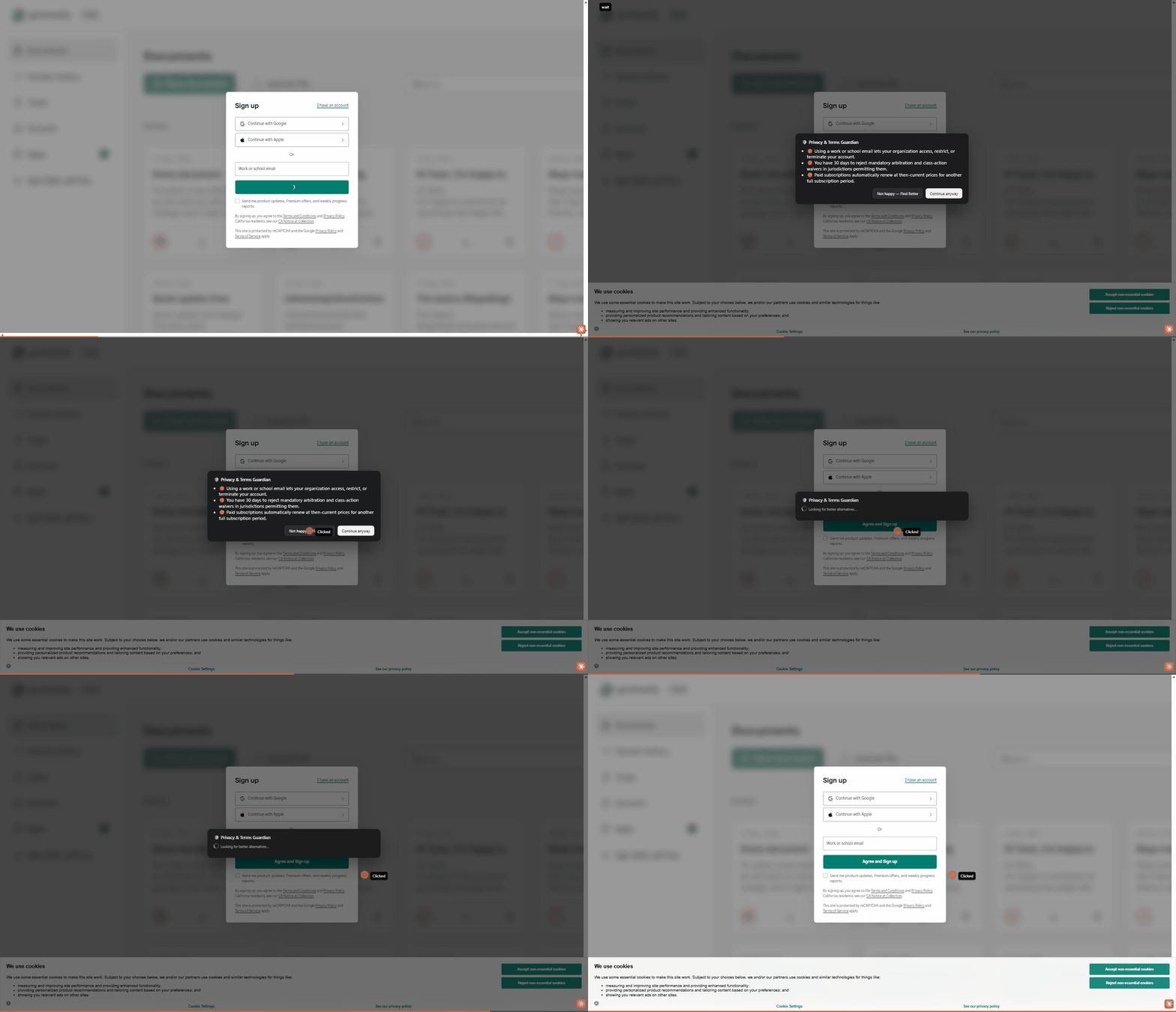
privacy-guardian-demo.gif — unedited capture, September 2026
Reviewed against what's already out there
AI summarizers like Simple Terms and SimpliTerms, the volunteer-curated Terms of Service; Didn't Read database, cookie-consent automators like Consent-O-Matic, and fixed-list redirect tools like Privacy Redirect each cover one slice of this. None do all of it, and none do it quite this way.
Compared against Simple Terms, SimpliTerms, T&C Reader, Polirizer, tosdr.org, Consent-O-Matic, and Privacy Redirect — September 2026.
Built on GPT-6 Astra — but not for every click
The extension never holds the API key. It talks to a small backend, which is the only thing that ever calls Astra — for reading policies, resolving contradictions between sections, and identifying real alternatives. Known cookie-consent platforms are handled with deterministic rules; Astra is reserved for judgment calls, not busywork.
The backend runs on Render's free tier, which sleeps after 15 minutes idle — the first request after a quiet spell can take up to 50 seconds to wake it back up. Every request after that is fast; this is a hosting-tier tradeoff, not the extension being slow.
Every action is validated before it runs — the extension refuses to touch password fields, submit buttons, or forms outside a cookie-consent dialog, regardless of what a model proposes.